Settling and expanding
Playable nowWhere your first city comes from, and how to get more.
You can do this now.
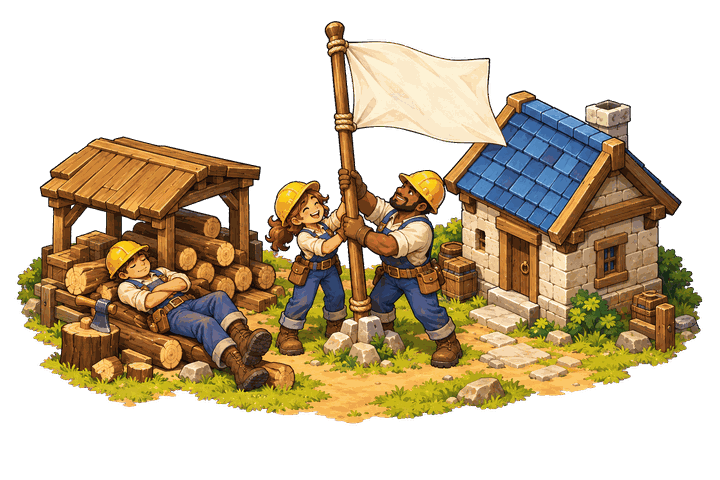
Your first city
You get one when you confirm your email address. The game picks the spot: an island near the middle of the map that still has room. It is called Settlement until you rename it, and it comes with a Town Hall and a Lumber Yard.
You can rename it from your city's Town Hall, as often as you like: 3 to 32 characters, and two cities may share a name. The name is public, and your city keeps the same address whatever you call it.
My empire shows each city's population, gold and resources in cards. Gold is the same empire purse in every city. If you have more than one city, the row at the end adds up what your empire holds and gains each hour.
Click Population or Gold to open that city's Town Hall, and click Wood to open its Lumber Yard. The island's trade good opens its producer after you build it; the row at the end remains a plain empire total.
The icon beside a city's name is what its island produces besides wood.
Founding another city
Open any island, click an empty slot, and pick the city you want to send the expedition from.
- 1,000 wood and 10 to 20 settlers, out of the city you send them from.
- 1,000 gold, out of your empire's purse.
- One transport, held until the expedition lands.
- Room under your Capitol Building, whose level plus one is how many cities you may hold.
- Room under your Civics research, which allows 2 cities until you research Administration at a Research Institute.
You need a Port in the city it sails from. The wood and the settlers are freight, so they have to be loaded onto a transport wherever they are going.
Every settler past 10 is a person your new city does not have to wait to grow. 20 is as many as its Town Hall supports.
A Carpenter in that city takes its share off the wood, so the same expedition costs less out of one city than another. It does not make the loading any quicker.
Loading takes as long as your Port's level says: 4 minutes at level 1, less at every level above it. Sailing then takes 2 minutes to another slot on the same island, or 5 minutes plus 5 for every hex of the crossing.
The slot is yours from the moment the transport leaves: the island shows it claimed with your name on it, and My empire counts down to it arriving. The city is there when it lands, called Settlement, with a Town Hall and a Lumber Yard.
A new city is also designed to cost one card, laid on that island's mural for as long as you hold the city. Cards do not exist yet, so nothing charges it.
Giving a city up
Open the city's Town Hall and press Abandon this city. You type the city's name to confirm, and then it happens at once and cannot be undone.
- Everything in it is lost: the buildings, the people and every resource in store. Nothing is refunded.
- The gold it earned stays in your purse, because gold is your empire's rather than a city's.
- Its slot goes back on the island for anyone to settle, yourself included.
- You get the room back under your Capitol Building.
Your capital cannot be abandoned. It is the city everything else is founded from.
Keeping them
- Every city outside your capital needs a Statehouse as high as the number of cities you hold outside your capital, or that city goes corrupt and both its people and its digging suffer.
The Capitol Building and the Statehouse both get expensive fast. Level 1 of either costs wood alone, and each level after it takes on one more resource: stone at level 2, coffee at level 3, glass at level 4, mana at level 5. Every level then wants more of each.
An island only ever has one of those four, so getting past the early levels means having cities on different islands. Growing wide is meant to be the slow part of the game.